
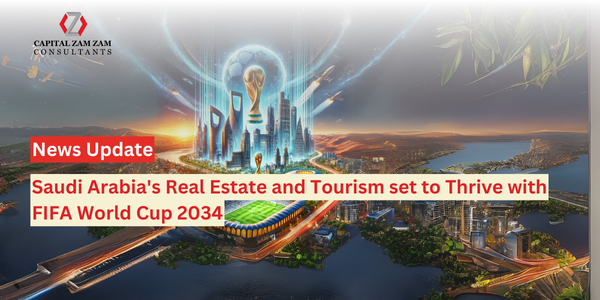
According to the analysts, the hosting of the FIFA World Cup by Saudi Arabia in 2034 will lead to significant economic growth in the country in the fields of infrastructure, tourism, and real estate.
The kingdom said that hosting of the event in 2034 will allow them to focus on the non-oil economy as the event will create more jobs in the fields of tourism and real estate. It is seen that the Kingdom’s non-oil economy has seen a consistent gross domestic growth between 4 to 5 percent each year since 2017 but this new era will enable a boom in the real estate development with the need for infrastructure such as stadiums and other related areas. This will eventually increase the country’s GDP to up to 5 percent leading up to the event in 2034.
Just like Qatar benefited from the FIFA World Cup hosting in 2022, economists have predicted that the non-oil economy would see a 4.4 percent growth in 2024 and 4.6 percent growth in 2025. The numbers are expected to rise due to increased activity in the region.
Saudi Arabia revealed design plans for the 92,000 capacity King Salman Stadium in Riyadh which will host the opening and the final match of the world cup in 2034. In total the country plans to build 15 stadiums of which four have already been built, three are in the construction phase, while 8 are in the planning phase.
In addition, 185,000 hotel rooms are planned to be built or renovated to cater the visitors for the event. More infrastructure such as roads and hotels are part of the $1.3 trillion projects which constitute the government’s vision under 2030 plans.
Matthew Green, head of research for the Middle East and North Africa at property consultancy CBRE, said that the event will have a massive impact on tourism, business and leisure. The loon-standing positive impact will be seen on the country’s infrastructure,
One of the possible impacts of the event will be an oversupply of hotel rooms, which will allow the country to offer more competitive rates to visitors just like Doha has emerged as one of the most affordable hospitality markets in the Middle East.
Key infrastructure improvements will be seen in Riyadh and Jeddah and will improve the overall position of Saudi Arabia in the MENA Region.
Saudi Arabia has diversified its income from an oil only income to incorporating sports into its development strategy. With huge Public Investment Funds, money is poured into the sports to strengthen the diversification strategy. The largest oil economy of the Arab world has made its way into sports partnerships, in which Kingdoms local team has managed to get in big names such as Cristiano Ronaldo, Karim Benzema and Neymar who have signed off on the most lucrative deals of the sports world.
Along with the physical stadiums being built, the Kingdom plans to live stream the sports events to boost their sports sector. PwC said that the use of 5D, cloud computing and other extended reality technology will redefine sports experience for the audience. Through digitalization, Saudi Arabia tends to position itself as a sports leader in the region, transforming the overall sports experience for the fans worldwide.